13. I looked for other opportunities in Korean equities
Screening, flow signals, SPACs, rights, and the difference between zero and unmeasured.
Investing on my own · Part 13/22 · Evidence through 2026-09-22. Historical research is distinct from DRY and live execution.
Beyond buybacks, I explored several directions in Korean equities: inexpensive companies with reasonable financial quality, unusual trading flows and liquidity patterns, and securities whose value depended on specific contractual events.
These were not one strategy. A screener, a flow signal, and a SPAC redemption study answered different questions. I wanted to keep both the results and the unfinished parts visible.
🔎 A tool for deciding what to read
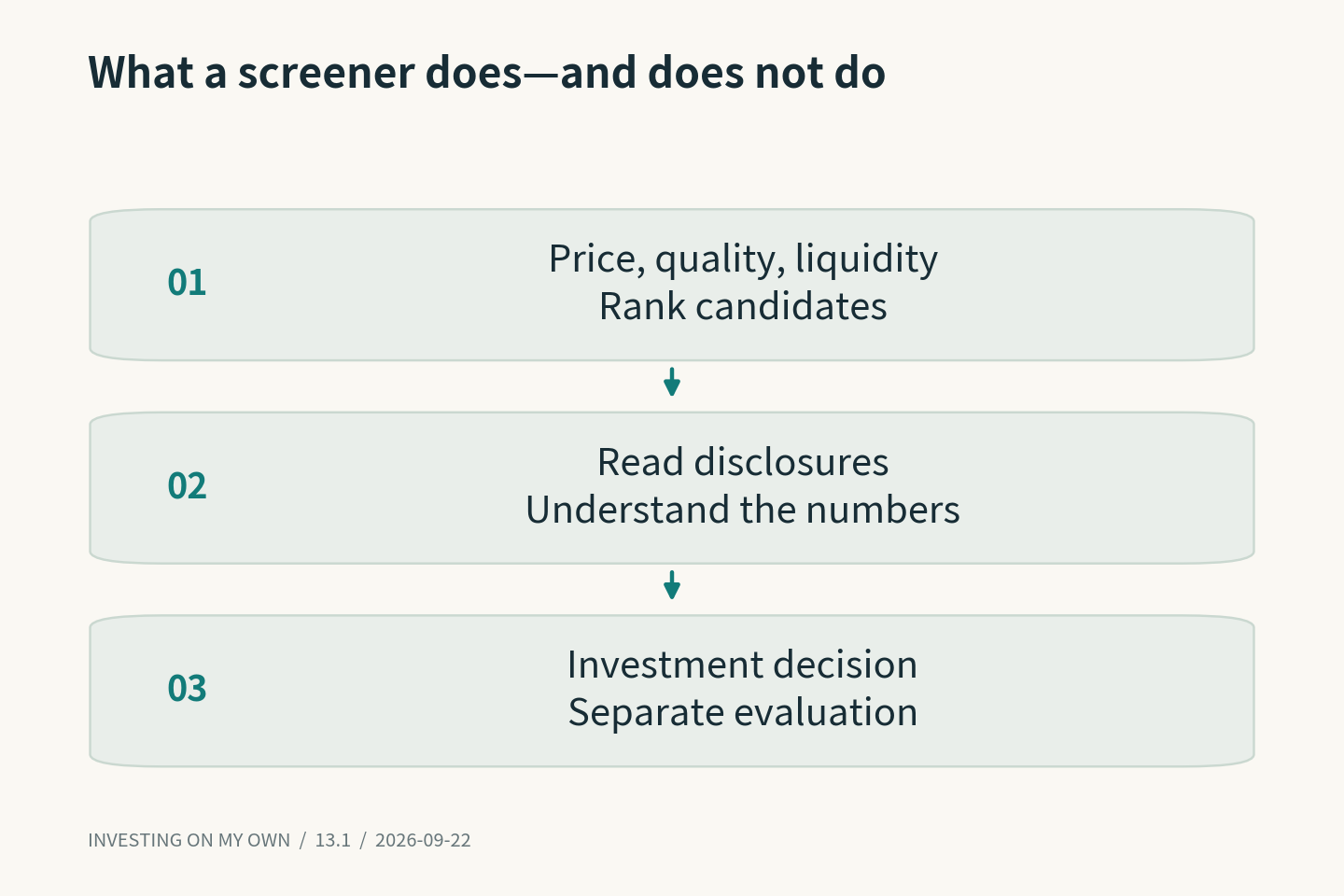
The value-and-quality screener was intended to narrow a large stock universe into companies worth examining. I considered valuation, profitability, financial condition, and whether the stock could actually be traded.
A low ratio alone was not a buy recommendation. A discount to book value did not establish the quality of the assets, and strong historical earnings did not guarantee that they would continue.
I separated the screening output from an investment decision. Building a ranking tool did not create a validated portfolio. Reading disclosures and understanding why a company appeared cheap or expensive remained another task.
Historical screening also required disclosure dates, not just accounting period-end dates. A December financial statement was not necessarily public in December. This was closely related to the information-timing issue I had encountered with exchange announcements.
📊 Flows and liquidity patterns
Another group of experiments examined investor trading flows, unusual volume, reversals, and liquidity-related effects. I wanted to know whether following concentrated buying helped, or whether temporary pressure created a subsequent reversal instead.
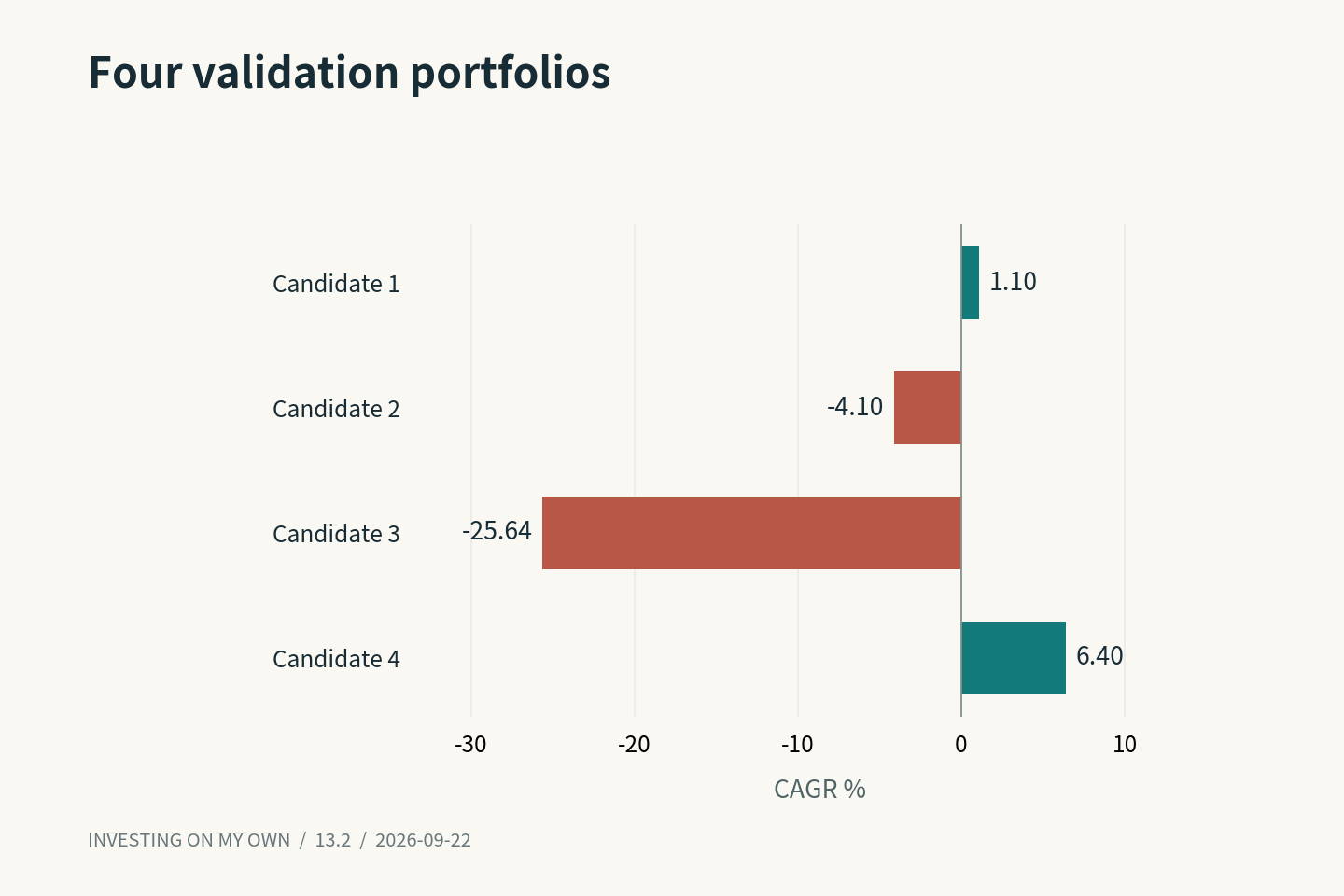
Four candidates produced 2019–2023 validation annualized returns of positive 1.10%, negative 4.10%, negative 25.64%, and positive 6.40%: institutional-sell reversal, a retail-flow proxy, market-relative reversal, and a liquidity-improvement shock. These were separate portfolios, not a combined account.
The two positive figures were not enough. None of the four passed the comparison-based evaluation. I needed to distinguish an additional effect from exposure to a rising market or a different level of risk.
That did not prove investor-flow data was useless. It meant the tested rules, costs, and periods did not establish a candidate worth adopting. Follow-up conditions changed after observing results could not be presented as if they had been fixed from the beginning.
🧩 SPACs required reading the terms
A special purpose acquisition company raises capital to pursue a merger. Liquidation if no deal occurs, or rights associated with a merger, can create cash-recovery paths unlike those of an ordinary operating company.
I did not treat a price below a familiar threshold as automatically safe. Deposited funds, expenses, timing, merger terms, share splits, and conversion ratios all mattered. Assigning every SPAC a fixed KRW 2,000 recovery value would simplify the dataset by discarding important differences.
The investigation covered 376 SPACs and more than 130,000 corporate-action records. Multiple disclosures often described stages of one underlying event, so counting documents was not the same as counting opportunities.
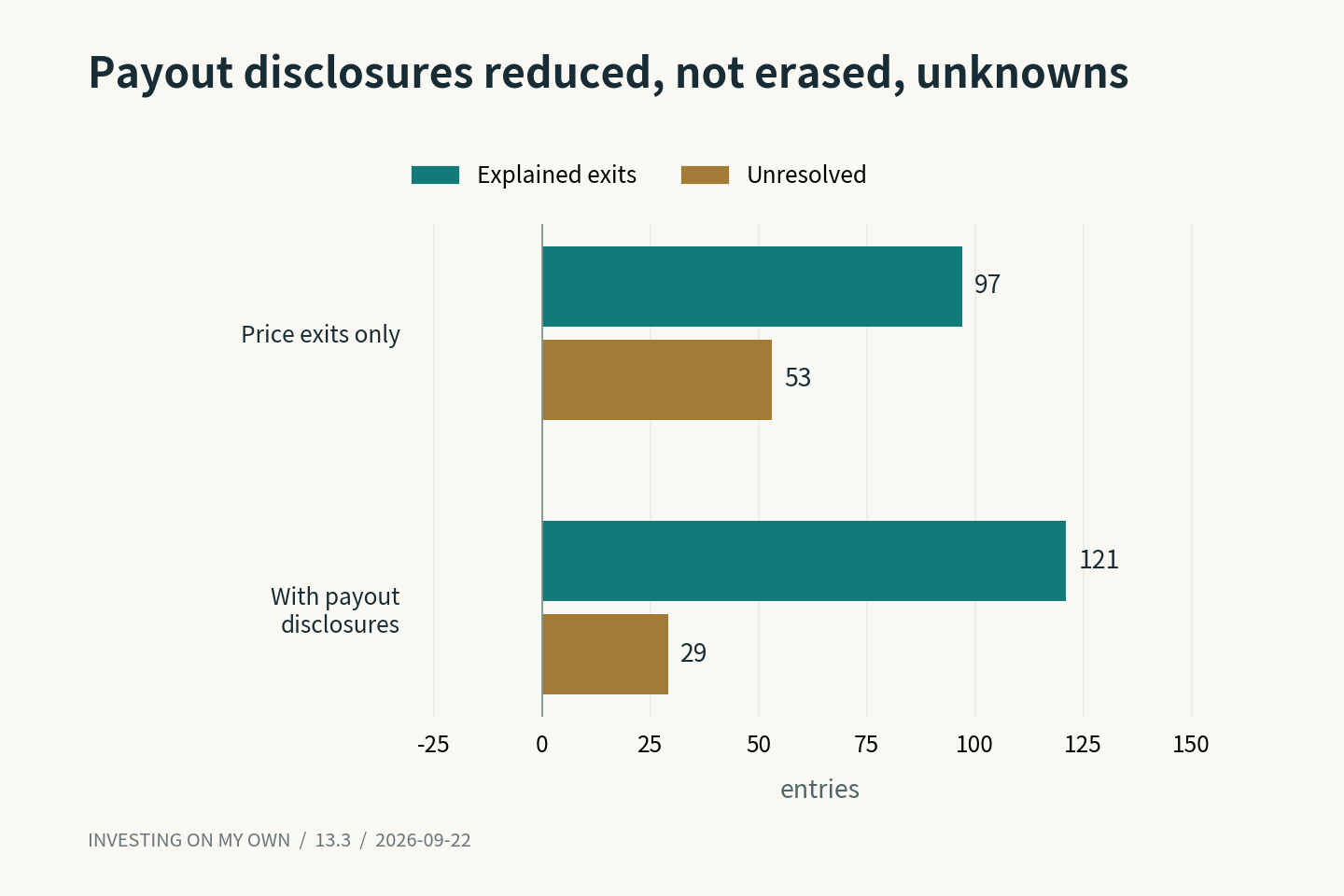
Initially, price-based exits explained 97 of 150 entries, leaving 53 unresolved. Adding public payout information increased explained exits to 121, with 29 still unresolved.
The supplemented closed sample had a mean return of approximately 3.18% and a median of 2.56%. Those were not annual returns. Holding periods differed, and the 29 unresolved cases were not included in the closed-sample average.
This distinction was central to the work. The return on cases with a known recovery was not a substitute for the return on the entire strategy. Missing exits could not be assumed harmless just because they complicated the summary.
📝 Where rights and convertibles remained unfinished
I also examined subscription rights and convertible securities. Their relationship to ordinary shares suggested possible pricing comparisons, but those comparisons required exercise prices, exercise windows, conversion ratios, and adjustment clauses.
The rights-related collection reached 4,084 records across 1,031 ISINs, while the convertible-bond terms collection contained 5,948 records. Those are data-inventory counts, not counts of verified profitable trades.
Knowing the terms was still insufficient when matching price observations were missing. Some instruments could not be evaluated. The correct result in those cases was “not measured,” not a return of zero and not proof that no opportunity existed.
Filling blank results with zeros would have made the study appear more complete than it was. It would also have hidden the precise reason further analysis stopped.
The Korean-equity work therefore ended in several different states. Screening remained a way to prioritize companies for reading. Flow candidates had documented rejection reasons. Special-situation work produced a better reconstruction of conditions and recovery paths, with unresolved cases retained.
I could not honestly combine all of that into one performance chart. What I could preserve was the boundary of each experiment: what information existed, what was tested, and which missing observation prevented the next calculation. That record should make a future restart more useful than repeating the same search from scratch.
Previous · Series index · Next